White PaperResearch commissioned by CX Assist · 2025
The Hybrid Advantage: Why AI-Human Voice AI Is the Only Model That Scales, Satisfies, and Survives Regulation
A global white paper for call centre operators, BPO leaders, and enterprise CX decision-makers. Examining consumer trust data, cost benchmarks, performance metrics, and the global regulatory landscape to make the definitive case for the AI-human hybrid model.
PH
Paul Hanner
CX Assist · cx-assist.com
Published: April 2025
Executive Summary
The global call centre industry stands at an inflection point. Artificial intelligence has moved from pilot project to production reality, yet the data tells a story that neither pure-AI evangelists nor human-only traditionalists want to hear: neither extreme works on its own.
AI-only deployments are failing to win consumer trust. Human-only operations cannot compete on cost. And regulators around the world are rapidly closing the window on undisclosed, unaccountable automated voice interactions.
The answer — supported by a growing body of research, real-world performance data, and emerging legislation across the US, EU, UK, Australia, India, and beyond — is the AI-human hybrid model. This approach pairs the speed, scalability, and cost-efficiency of voice AI with the empathy, judgement, and trust that only a human agent can provide.
93.4%
of consumers prefer interacting with a human over AI
Kinsta, 2025
49.6%
would cancel a service over AI-only customer service
Kinsta, 2025
$47.5B
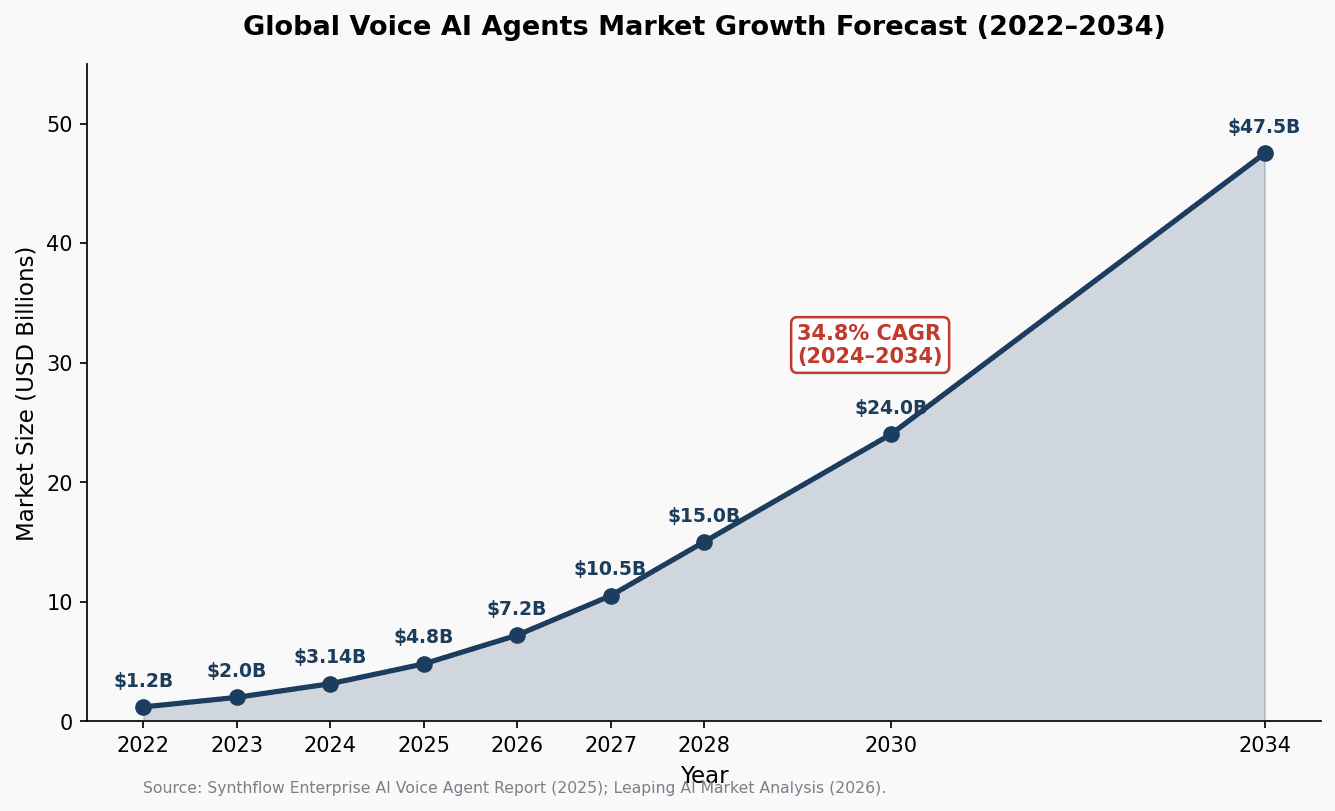
projected global Voice AI market by 2034 — 34.8% CAGR
Synthflow, 2025
~85%
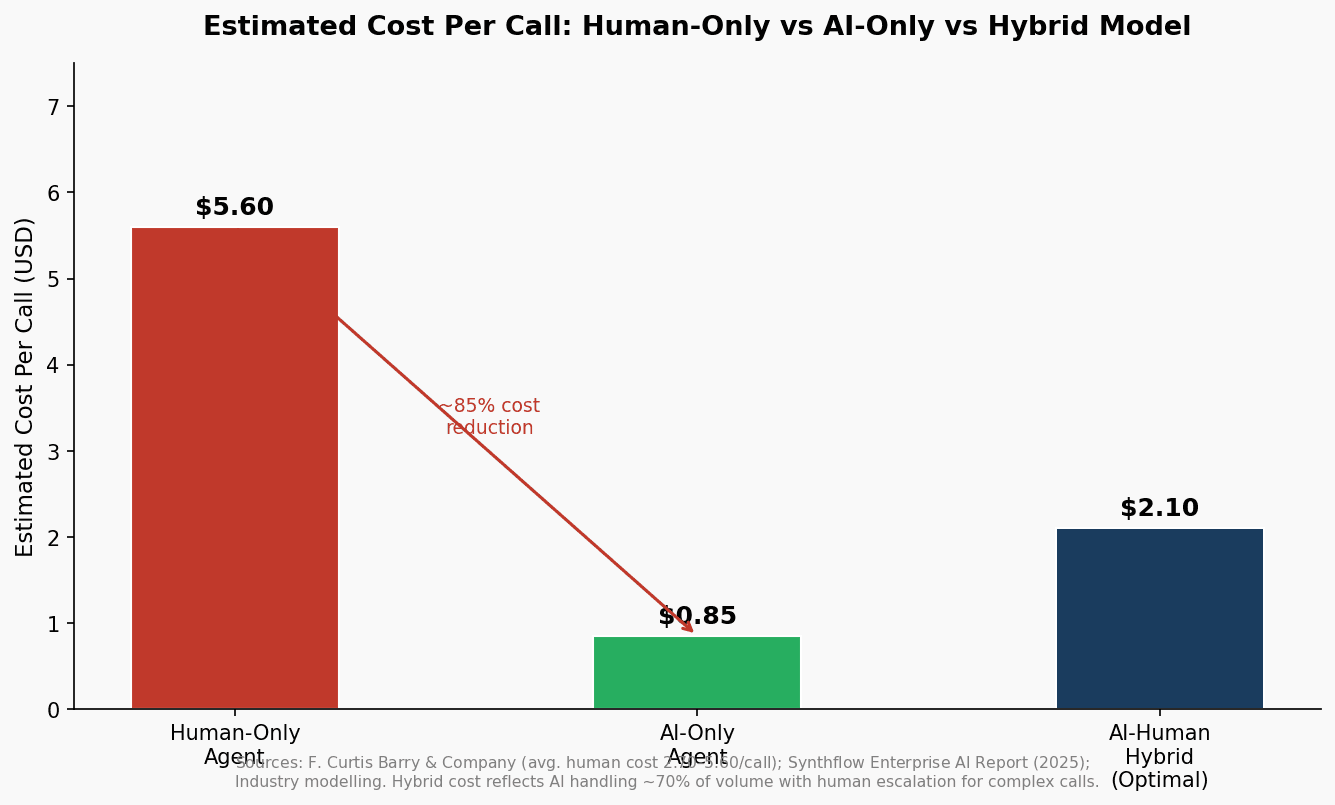
cost reduction achievable with an AI-assisted hybrid model
Industry modelling
Contents
- 01The State of Voice AI in 2025: A Market at Tipping Point
- 02Why AI-Only Is Not the Answer: The Consumer Trust Deficit
- 03Why Human-Only Cannot Compete: The Economics of Scale
- 04The Hybrid Model: Performance Metrics That Prove the Case
- 05The Global Legal Landscape: Regulation Is Coming — Are You Ready?
- 06How the Hybrid Model Works in Practice: Architecture, Agent Assist & Continuous Improvement
- 07Looking Ahead: 2026–2030: The Hybrid-First Future
Section 01
The State of Voice AI in 2025
A Market at Tipping Point
Explosive Market Growth
The Voice AI agents market has expanded from USD 3.14 billion in 2024 to a projected USD 47.5 billion by 2034, representing a compound annual growth rate (CAGR) of 34.8%. North America currently leads with over 40% market share, while the Banking, Financial Services, and Insurance (BFSI) sector accounts for 32.9% of deployments. Healthcare AI voice adoption is expanding at a 37.3% CAGR through 2030, and retail at 31.5%.
Three Forces Driving Adoption
- Ultra-low latency inference: Best-in-class AI voice systems now achieve sub-500ms response times, making conversations feel genuinely natural.
- Enterprise cost optimisation: AI-driven customer engagement is replacing traditional call volumes at a fraction of the cost.
- Rising regulatory demands: Compliance requirements for auditable, transparent automation are accelerating structured deployment over ad-hoc experimentation.
The Technology Maturity Curve
Modern voice AI systems have moved well beyond the rigid IVR menus of the previous decade. Today's platforms use real-time large language models (LLMs), natural language understanding (NLU), and voice-to-voice processing to conduct fluid, context-aware conversations. They integrate directly with CRM platforms, ticketing systems, and telephony APIs, enabling complete call handling — from authentication to escalation and resolution. Enterprises deploying these systems report a 14% increase in issue resolution per hour and a 9% decrease in average handling time.
Section 02
Why AI-Only Is Not the Answer
The Consumer Trust Deficit
What the Data Actually Says
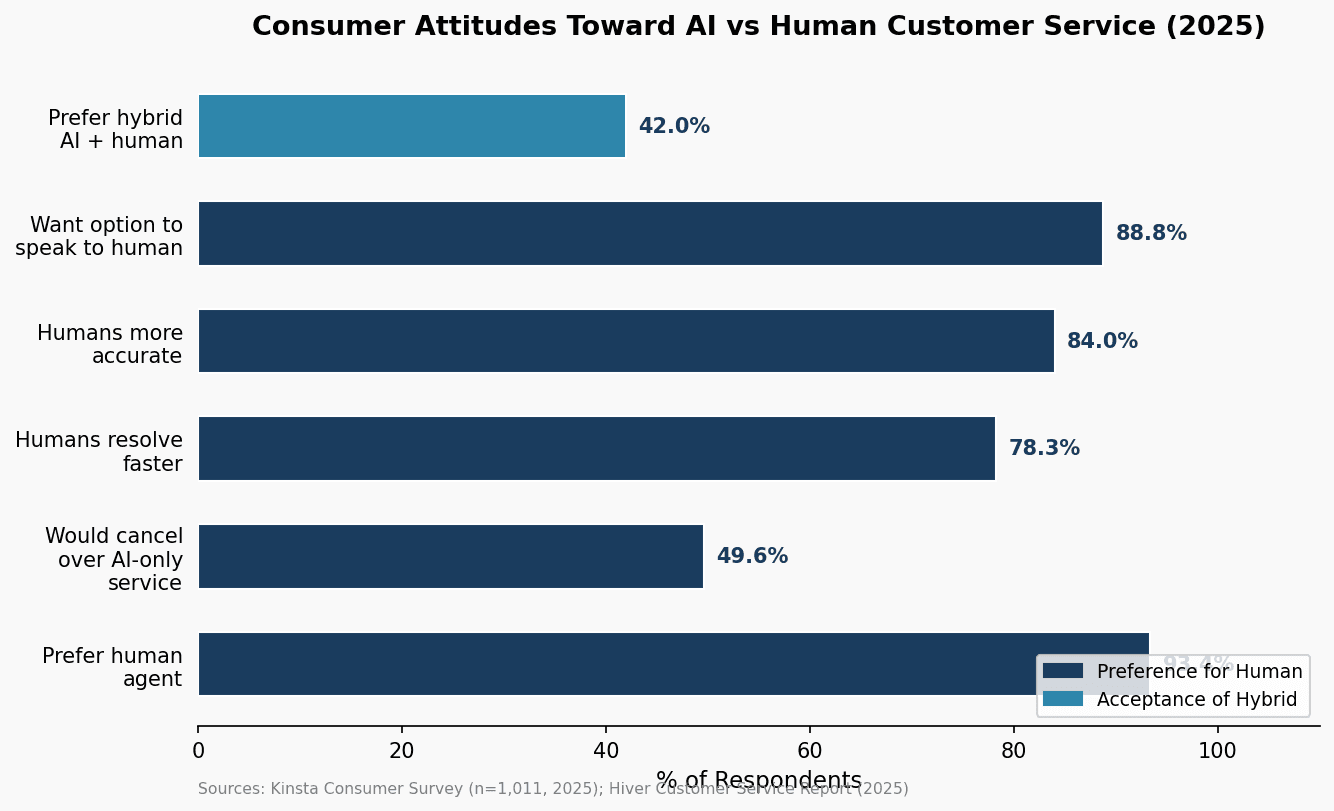
Despite rapid technological advancement, consumer sentiment has not kept pace with vendor enthusiasm. A nationally representative survey of 1,011 US consumers (Propeller Insights / Kinsta, Feb–Mar 2025) produced findings that should give any AI-only advocate pause:
- 93.4% of consumers prefer interacting with a human over AI
- 78.3% say humans resolve customer service problems faster
- 84.0% say humans are more accurate
- 88.8% believe companies should always offer the option to speak with a human
- 49.6% would cancel a service over AI-driven customer service with no human option
- 41.5% would pay extra for access to human representatives
- 80.6% believe AI is used primarily to save money, not improve service
- 71.0% encountered situations where AI struggled with complex issues
The Generational Divide
Consumer attitudes toward AI vary significantly by generation. Only 14% of Baby Boomers report a positive, memorable experience with a brand's AI in high-stakes purchase situations. By contrast, nearly 60% of Gen Z consumers report positive AI interactions in high-stakes scenarios. Critically, even among the most AI-accepting generation, 77% of all consumers say they would be more willing to engage with AI if they knew how to connect with a real person when needed — the exact premise of the hybrid model.
Where AI Excels and Where It Falls Short
The research is consistent: consumers accept and even prefer AI for simple, transactional tasks — checking inventory, getting store hours, appointment reminders, and order status updates. The moment interactions become complex, emotionally charged, or high-stakes, trust in AI collapses. 53% of consumers believe solving complicated problems is where AI performs worst. A peer-reviewed study (IJCET, March 2025, n=100) confirmed that AI chatbots score higher on speed and availability, while human agents score higher on empathy and trust — explicitly recommending hybrid deployment as the optimal model.
Section 03
Why Human-Only Cannot Compete
The Economics of Scale
The Cost Per Call Reality
The average cost per call in a human-staffed call centre ranges between USD 2.70 and USD 5.60. AI voice agents operate at approximately USD 0.08 per minute — meaning a typical 3-minute routine call costs around USD 0.24, compared to USD 3–5 for the same call handled by a human agent. A contact centre handling 100,000 calls per month could reduce its operational cost by millions annually by routing even 60–70% of volume through AI.
The Agent Attrition Crisis
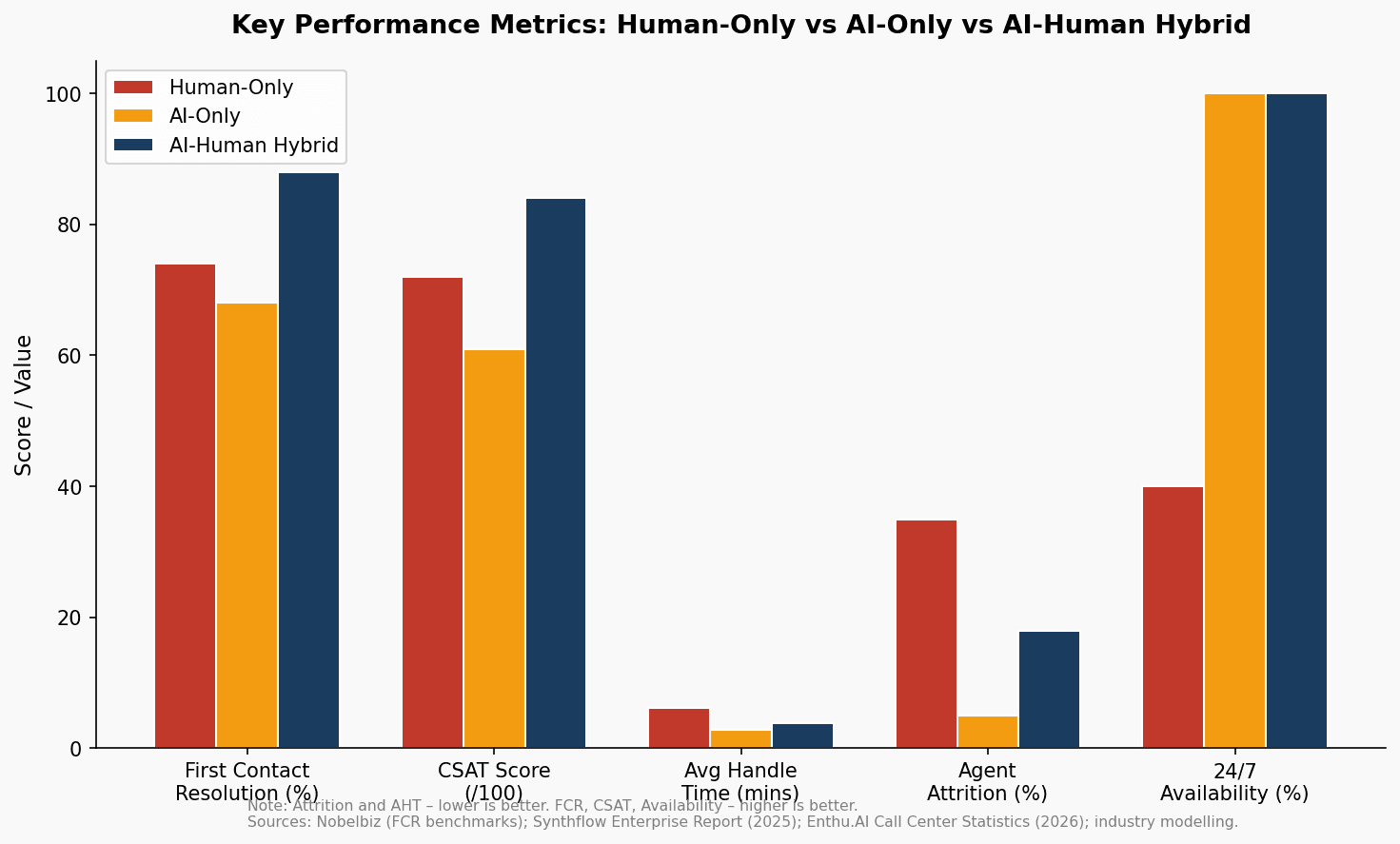
87% of call centre agents cite job stress as a significant turnover factor. The industry average attrition rate in human-only environments is approximately 35% annually. The cost of replacing a single agent is estimated at 50–200% of their annual salary. AI does not resign, does not call in sick (industry average: 8.2 absentee days per agent per year), and does not require a performance improvement plan. Counterintuitively, introducing AI into the agent environment actually improves human agent retention — when AI handles repetitive calls, human agents are left with more interesting, higher-value work.
Scalability and 24/7 Availability
Human-only operations are fundamentally constrained by shift patterns, time zones, and headcount. Scaling to meet a sudden spike in call volume requires weeks of recruitment and training. AI scales instantly. The hybrid model can absorb volume spikes through AI capacity while maintaining human availability for the calls that genuinely require it. 24/7 availability is provided at no additional marginal cost, with human agents available during core hours for escalations.
Section 04
The Hybrid Model
Performance Metrics That Prove the Case
First Contact Resolution
Best-in-class call centres achieve a First Contact Resolution (FCR) rate of 74% or higher. Human-only centres typically operate in the 70–79% range. AI-only deployments often underperform on FCR because they struggle with complex or ambiguous queries, leading to repeat contacts. Hybrid models — where AI handles routine queries and seamlessly escalates complex ones to human agents with full context transfer — consistently achieve FCR rates of 85–90%+.
Customer Satisfaction (CSAT)
CSAT is the primary metric used by 80% of customer service organisations. Human-only centres typically score in the 70–75 range on a 100-point scale. Hybrid models consistently achieve CSAT scores of 80–88. Improving agent satisfaction by even one point can boost customer satisfaction scores by 62% (Invoca).
Real-World ROI Evidence
- 35–50% reduction in Average Handle Time (AHT)
- 25–40% reduction in labour costs
- 15–20 point improvement in Customer Satisfaction (CSAT) scores
- 20–30% more calls handled with 30–40% fewer agents
- ROI typically achieved within 6–12 months of deployment
Section 05
The Global Legal Landscape
Regulation Is Coming — Are You Ready?
United States: The FCC's 2024 Watershed Ruling
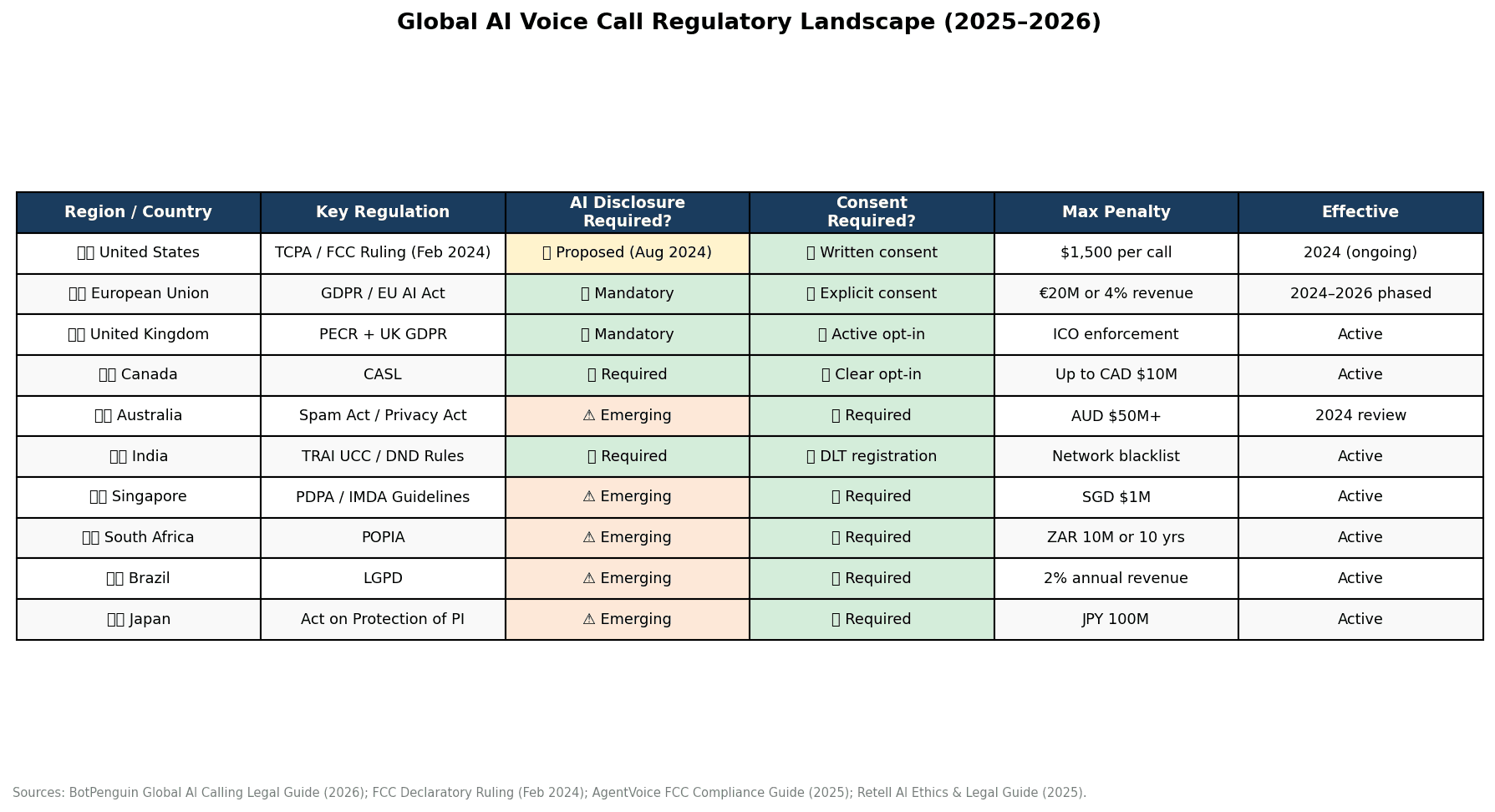
In February 2024, the FCC issued a landmark Declaratory Ruling classifying AI-generated voice calls under the Telephone Consumer Protection Act (TCPA). Any AI-generated voice call now requires prior express written consent, clear identification disclosures, and opt-out options. Violations carry penalties of up to USD 1,500 per call. State-level legislation in Utah, California, New York, Illinois, and Massachusetts is adding further requirements.
European Union: GDPR and the EU AI Act
In the EU, AI voice interactions are treated as data processing under GDPR. Non-compliance can result in fines of up to €20 million or 4% of global annual revenue. The EU AI Act — in force since 2024 with phased implementation through 2026 — introduces transparency, human oversight, and auditability requirements for customer-facing AI voice systems.
UK, Canada, Australia, India & Beyond
The UK's PECR and UK GDPR require active opt-in consent and clear disclosure for AI-driven calls. Canada's CASL, Australia's Privacy Act review (2024), India's TRAI UCC framework, and data protection laws across Singapore, South Africa, Brazil, and Japan all apply to AI voice interactions. The direction of travel is universal: undisclosed, unconsented AI voice calls are becoming illegal everywhere.
The Compliance Case for the Hybrid Model
A properly structured AI-human hybrid deployment discloses AI involvement at the start of every interaction, maintains human oversight and escalation pathways that satisfy 'human in the loop' requirements, creates auditable call records, and enables consent management and opt-out handling at scale. Businesses that invest in hybrid infrastructure now are building a compliance framework that will protect them as regulation tightens across every market.
- Discloses AI involvement at the start of every interaction
- Maintains human oversight and escalation pathways
- Creates auditable call records with full transcripts and outcome logs
- Enables consent management and opt-out handling at scale
- Provides the accountability and transparency regulators are demanding
Section 06
How the Hybrid Model Works in Practice
Architecture, Agent Assist & Continuous Improvement
The Architecture of a Hybrid Voice AI System
- Layer 1 — AI Front-End: The AI voice agent handles the initial interaction, authenticates the caller, identifies intent, retrieves CRM data, and resolves routine queries end-to-end.
- Layer 2 — Intelligent Routing: When the AI detects complexity, emotional distress, or regulatory sensitivity, it initiates a warm transfer with a full context package — transcript, intent summary, customer history, and recommended next steps.
- Layer 3 — Human Agent with AI Assist: The human agent receives the escalated call with full context, supported by real-time AI assistance — suggested responses, knowledge base surfacing, compliance prompts, and post-call summary generation.
Real-Time Agent Assist: The Force Multiplier
One of the most powerful elements of the hybrid model is real-time agent assist technology. These tools listen to ongoing conversations, understand customer intent, and guide human agents with live recommendations — surfacing the right knowledge base article, suggesting tone and phrasing, flagging compliance risks, and auto-generating wrap-up notes into the CRM. New-hire ramp time shortens, call quality improves, and supervisors gain live visibility into every call.
Continuous Improvement Through Data
Every interaction in a hybrid system generates data. AI-powered voice analytics analyse tone, sentiment shifts, silence duration, talk-over moments, and keyword trends across 100% of calls — compared to the 2–5% typically reviewed manually in human-only environments. This creates a continuous improvement loop: the AI gets better at handling routine queries, human agents receive targeted coaching, and the business gains genuine insight into the root causes of customer dissatisfaction.
Section 07
Looking Ahead: 2026–2030
The Hybrid-First Future
Regulation Will Tighten Further
The regulatory trajectory is clear. Every major market is moving toward mandatory AI disclosure, explicit consent requirements, and human oversight mandates. The EU AI Act's phased implementation will impose additional requirements on high-risk AI systems through 2026. Businesses that have not built compliance into their AI voice architecture will face increasing legal exposure.
Consumer Acceptance Will Grow — But Slowly
Consumer acceptance of AI in customer service will increase over time, driven by generational change and improving AI quality. However, the preference for human agents in complex, high-stakes interactions is likely to persist for the foreseeable future. The hybrid model is the only architecture that serves both the current majority (who prefer humans) and the emerging majority (who are comfortable with AI).
The Winners Will Be Hybrid-First
By 2030, the call centre and BPO landscape will be dominated by operators who made the hybrid investment early. By 2028, Gartner predicts that 40% of enterprise voice interactions will include real-time sentiment adaptation. The hybrid model is not a compromise — it is the optimal solution commercially, operationally, legally, and from the perspective of the customers who ultimately determine whether any of this matters.
Conclusion
The Case Is Closed
AI-only voice deployments fail on consumer trust, struggle with complex queries, and are increasingly non-compliant with global regulation. Human-only operations cannot compete on cost, cannot scale efficiently, and cannot provide the 24/7 availability that modern customers expect. The AI-human hybrid model resolves all of these tensions simultaneously.
For call centre operators, BPO leaders, and enterprise CX decision-makers, the strategic question is no longer whether to adopt AI — it is how to integrate it in a way that enhances rather than undermines the customer experience. The answer, supported by data, regulation, and commercial logic, is the hybrid model: AI at the front, humans at the heart.
Organisations that build hybrid AI-human voice infrastructure now will be better positioned to serve their customers, satisfy their regulators, and outcompete their rivals — not just in 2025, but across the decade ahead.
Ready to explore a hybrid deployment?
Speak with the CX Assist team to understand how a hybrid AI-human voice model can work for your business.
References & Sources
- [1]Kinsta / Propeller Insights. (2025). AI has taken over customer service, but consumers want humans back. National online survey, n=1,011 US consumers.
- [2]Hiver. (2025). AI vs Human in Customer Service: What Our 2025 Report Reveals.
- [3]Synthflow. (2025). Top 10 Enterprise AI Voice Agent Vendors for Contact Centers in 2025.
- [4]Enthu.AI. (2026). 51 Latest Call Center Statistics with Sources for 2026.
- [5]Robylon AI. (2026). 10 Voice AI Trends Transforming Call Centers in 2026.
- [6]Leaping AI. (2026). Voice AI: Transforming Call Center Operations and Customer Service in 2026.
- [7]BotPenguin. (2026). Is AI Calling Legal in the U.S., EU, India & Beyond? 2025 Guide.
- [8]AgentVoice. (2025). FCC Regulations for AI-Generated Calls.
- [9]Retell AI. (2025). Ethics and AI Phone Calls: Are AI Voices Legal?
- [10]Invoca. (2025). Survey: Consumers Still Value Human Assistance Over the Speed of AI.
- [11]Mangipudi, P. (2025). AI Powered Chatbots vs Human Agents. IJCET, 16(2), 11–36.
- [12]Gartner. (2025). Magic Quadrant for Conversational AI Platforms.
- [13]McKinsey & Company. (2024). The State of AI in Customer Service.
- [14]F. Curtis Barry & Company. Industry Cost Per Call Benchmarks.
- [15]Nobelbiz. First Call Resolution Benchmarks.
- [16]Research and Markets. (2024). Global Call Center Market Forecast 2027.
This white paper was commissioned by CX Assist (cx-assist.com). All statistics are sourced from publicly available research and industry reports. © 2025 CX Assist. All rights reserved.